

Buying guidance · Quick couplers
Excavator Quick Couplers:
Faster Changes,
More Useful Work
The right attachment only earns its keep when it is on the machine. A properly matched quick coupler makes moving between digging, cleanup and finish work a more practical part of the day.

Put the right tool on the next task.
A quick coupler sits between the excavator linkage and a compatible attachment. It lets the machine pick up and secure that attachment through the coupler interface instead of repeating a full direct-pin installation at every change. A manual coupler still requires the operator to complete the prescribed locking and connection checks.
The jobsite benefit extends beyond the change itself. When switching tools is less disruptive, it becomes more practical to use a narrow bucket for a trench, a wider digging bucket for bulk removal and a smooth-edge bucket for the finish. That can reduce unnecessary excavation and follow-up shaping compared with trying to complete every stage with the same bucket.
On a clearing job, the same principle applies: loosen suitable roots with a ripper, gather loose material with a rake, then return to a bucket for soil work. Each attachment has a defined task. The coupler helps the crew move between them without treating every change as a separate installation project.
Where a quick coupler delivers daily value.
- Utility and drainage work: change bucket width as the excavation changes, then fit a ditching bucket for loose-material cleanup.
- Property clearing: alternate between compatible digging and debris-handling attachments as material becomes exposed.
- Finish grading: move from bulk excavation to the edge and width needed for the final profile.
- Mixed small jobs: bring a useful attachment lineup for one carrier instead of accepting the limitations of one bucket throughout the visit.
The return depends on how often you change tools and what those changes let you accomplish. There is no universal minutes-per-change or payback figure. Compare your current changeover routine, attachment use and cleanup time when deciding which configuration earns a place on the machine.
East Attachments: standard or hydraulic tilting.
The East Attachments Manual Quick Coupler is offered for machine-specific builds across the listed 1.5–70 ton excavator range. That range starts the discussion; the actual linkage and attachment geometry determine fitment.
| Configuration | Function | Best reason to discuss it |
|---|---|---|
| Standard manual coupler | Manual attachment locking with machine-specific geometry | Routine changes between compatible buckets and tools |
| Hydraulic tilting option | 45° left and 45° right; single or dual cylinder configurations | Adjusting a compatible attachment’s angle for slopes, contours and drainage work |
| Included choices | Black or yellow paint; one set of pins included with standard and tilting coupler options | Specify the complete arrangement in one machine-specific quote |
What the tilting option adds on site.
Hydraulic tilt changes the attachment’s angle relative to the excavator. With a suitable bucket, this can help an operator follow a specified bank, swale or cross-slope from a workable machine position. Where access is constrained, adjusting the cutting edge can reduce some repositioning needed to reach the required angle.
It does not eliminate the need for a stable machine position or correct reach. Review the complete attachment weight, clearance and intended work with the shop. The single- or dual-cylinder choice should follow the proposed build and application, rather than being treated as a standalone capacity rating.
Hydraulic tilt and attachment locking are separate functions. The listed tilting option adds angular movement; it should not be read as an automatic or in-cab attachment-release feature. Confirm the locking procedure for the supplied coupler. Hydraulic hoses and hydraulic lines are not included with hydraulic configurations; discuss the machine’s available circuit, flow, pressure and connection requirements when quoting.
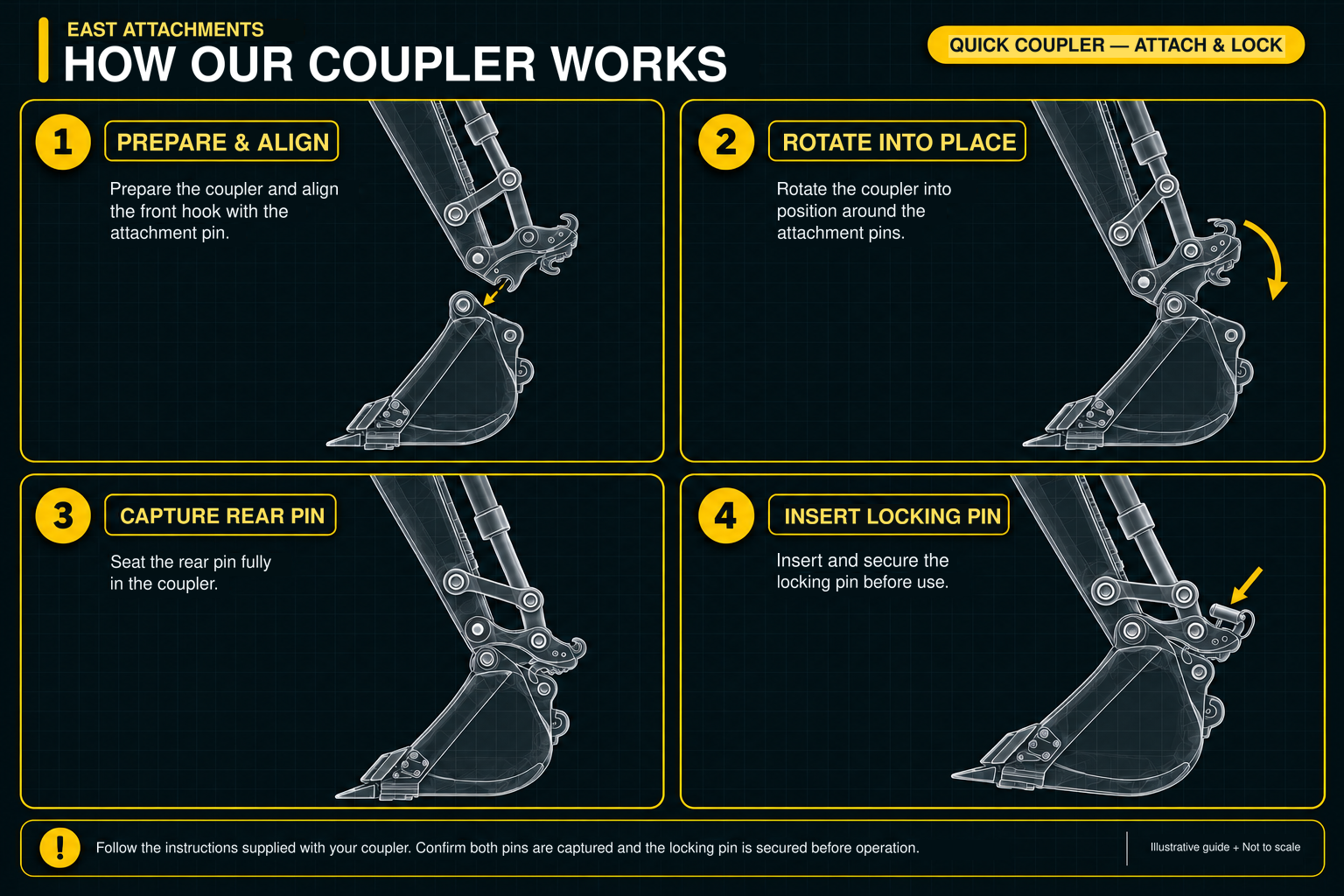
Understand the connection before the first change.
The East Attachments overview illustrates four stages: prepare and align, rotate into place, capture the rear pin, then insert and secure the locking pin with the coupler fully seated. Both attachment pins must be correctly captured and the specified locking components secured. The illustration explains the arrangement; it does not replace equipment-specific training.
Keep the attachment supported on the ground for manual inspection and locking work, following the machine’s shutdown and isolation instructions. Before use, complete the manufacturer-specified connection test and verify engagement. Keep people clear of the operating swing area and out from under raised attachments. Inspect and maintain the coupler, pins and retention components on the prescribed schedule.
These practices are consistent with NIOSH guidance on excavator quick couplers. If engagement is uncertain or components are damaged, stop and resolve the issue before operating.
Fitment means more than matching pin diameter.
Two attachments can have the same pin diameter and still have incompatible spacing, width or pickup geometry. Supply the excavator make and model, existing coupler identification and clear photographs of the linkage and attachment mounts.
Use the excavator attachment guide sheet to record pin centers first, inside ear width second, and pin diameters third. Record the main pin and power-link pin separately where required. The shop must review machine-side fitment and the attachment-side interface, including clearance through the working range.
A coupler also adds weight and changes the distance between the linkage and the tool. Account for the complete setup when reviewing lift capacity, digging geometry and clearance. It does not increase the excavator’s rated lifting capacity.
Adapters solve a different connection problem.
The Universal Skid Steer Quick Attach combines an excavator-specific upper mount with a universal skid-steer attachment interface and manual locking handles. It can make compatible tools from an existing attachment lineup useful on an excavator, subject to a full fitment and application review. Mechanical connection alone does not establish hydraulic or operating compatibility. Pins for this adapter are sold separately.
For an existing excavator attachment that needs a different hookup, discuss the Excavator Hookup Mounting Plate. Weld-on and bolt-on options are available, with black or yellow paint and custom modifications by request. It is a conversion component, not an attachment-release mechanism, and pins are sold separately. Confirm the attachment structure and conversion plan with the shop.
Send the details that make the quote useful.
- Excavator make and model, current coupler type and linkage photos.
- Pin centers, inside ear width and individual pin diameters in millimeters.
- The buckets and tools you intend to use, with mount photos and dimensions.
- Standard or tilting configuration, intended tasks and paint preference.
- Available hydraulic details for tilt or powered attachments.
- Delivery ZIP code, unloading arrangements and target timeline.
Current published coupler build timing is approximately 10–15 working days after required measurements are confirmed, subject to shop volume and configuration. Freight transit is additional. Start with the work you want the machine to perform; East Attachments can review the connection, options and complete build with you.